Search This Blog

Showing posts with label sensor. Show all posts

Friday, 21 April 2023

IR (infrared ) sensor

 An IR sensor, short for Infrared sensor, is a device that is capable of detecting infrared radiation or heat. It can measure the amount of infrared radiation emitted by an object and convert it into an electrical signal, which can be used for various purposes. IR sensors are widely used in a variety of applications, including remote controls, security systems, and temperature sensors.


How does an IR sensor work?

An IR sensor works by detecting the amount of infrared radiation emitted by an object. Every object emits some level of infrared radiation, which can be detected by an IR sensor. An IR sensor typically consists of an IR emitter and an IR receiver. The emitter emits a beam of infrared radiation, which is then reflected back by the object being detected. The receiver then detects the reflected infrared radiation and converts it into an electrical signal.
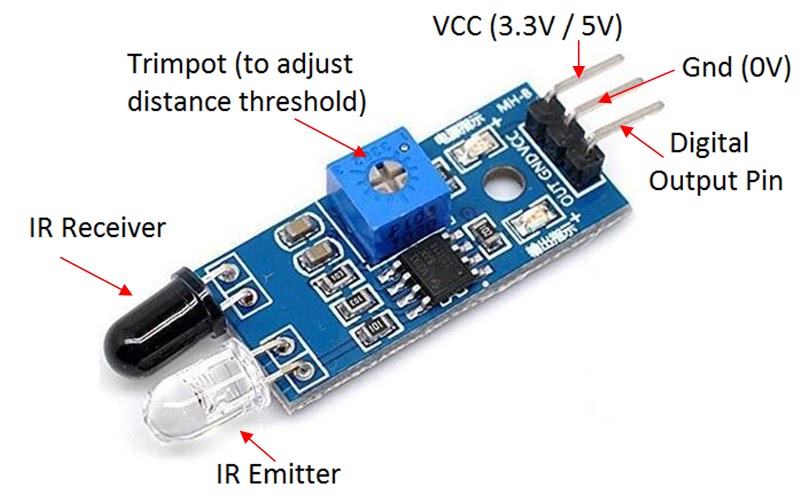


Types of IR sensors

There are two main types of IR sensors: active and passive.

Active IR sensors emit infrared radiation and then detect the radiation that is reflected back. This type of IR sensor is commonly used in proximity sensors, which can detect the presence of an object and measure the distance between the sensor and the object.

Passive IR sensors, on the other hand, detect the infrared radiation emitted by an object. This type of IR sensor is commonly used in temperature sensors and motion detectors.

Applications of IR sensors

IR sensors have a wide range of applications. Some of the most common applications include:

  1. Remote controls: IR sensors are commonly used in remote controls for TVs, DVD players, and other electronic devices. The sensor detects the infrared radiation emitted by the remote control and uses it to control the device.

  2. Security systems: IR sensors are commonly used in security systems to detect the presence of intruders. The sensor detects the infrared radiation emitted by a person's body heat and triggers an alarm if the person is detected.

  3. Temperature sensors: IR sensors can be used to measure the temperature of an object without touching it. This makes them ideal for use in applications where contact with the object is not possible or desirable.

  4. Proximity sensors: IR sensors can be used to detect the presence of an object and measure the distance between the sensor and the object. This makes them ideal for use in robotics and automation applications.

Conclusion

IR sensors are versatile devices that can be used in a variety of applications. They work by detecting the amount of infrared radiation emitted by an object and converting it into an electrical signal. IR sensors can be used in remote controls, security systems, temperature sensors, and proximity sensors, among other applications. As technology continues to advance, we can expect to see even more applications for IR sensors in the future.

LDR(light dependent resistor )/ photo resistor

 Light Dependent Resistors, or LDRs, are passive electronic components that can detect changes in light intensity and convert them into an electrical signal. They are also known as photoresistors, photocells, or light sensors. LDRs have a wide range of applications in electronics, including light-sensitive switches, automatic light control systems, burglar alarm systems, and photographic light meters.

LDRs are made of a semiconductor material that exhibits a property known as photoconductivity. When photons, or light particles, strike the surface of the semiconductor material, they generate electron-hole pairs, which can conduct electricity. The conductivity of the material increases with the number of electron-hole pairs generated, which in turn depends on the intensity of light.


LDRs are made of different semiconductor materials, such as cadmium sulfide (CdS), cadmium selenide (CdSe), and indium antimonide (InSb). The most commonly used material is CdS, which has a sensitivity range of 400-700 nm, covering the visible light spectrum. CdSe and InSb have a higher sensitivity range, covering the infrared spectrum.

LDRs are packaged in a variety of forms, including surface-mount packages, through-hole packages, and leaded packages. They are available in different shapes and sizes, from small cylindrical packages to large flat sensors. The sensing area of an LDR can range from a few square millimeters to several square centimeters.

LDRs have a nonlinear response to light, which means that their resistance changes rapidly over a narrow range of light intensity and slowly over a wide range. This nonlinear response can be compensated by using a logarithmic amplifier or a microcontroller with a built-in logarithmic function.

LDRs can be used in two configurations: series and parallel. In series configuration, the LDR is connected in series with a fixed resistor, and the output voltage is taken across the LDR. This configuration provides a voltage divider that varies with light intensity. In parallel configuration, the LDR is connected in parallel with a fixed resistor, and the output voltage is taken across both resistors. This configuration provides a voltage source that varies with light intensity.


LDRs have several advantages over other types of light sensors. They are low-cost, easy to use, and require no power to operate. They are also highly sensitive to changes in light intensity and can detect a wide range of light levels. However, LDRs have some limitations, such as slow response time, temperature sensitivity, and drift over time.

In conclusion, LDRs are an essential component in many electronic devices that require light sensing. They are inexpensive, easy to use, and highly sensitive to changes in light intensity. Their nonlinear response can be compensated by using logarithmic amplifiers or microcontrollers. LDRs have a wide range of applications in various fields, including robotics, automation, and security systems.

Thursday, 20 April 2023

MQ-2 gas sensor

 The MQ-2 gas sensor is a highly sensitive sensor module that is capable of detecting various types of gases such as methane, propane, hydrogen, smoke, and carbon monoxide. This gas sensor module is widely used in various industries, including automotive, aerospace, and manufacturing.

The MQ-2 gas sensor module is based on a micro-electromechanical system (MEMS) technology, which uses a small chip that contains a heater and a sensing element. The sensing element is made up of a metal oxide semiconductor (MOS) material that is highly sensitive to certain gases. When the gas is detected, the MOS material undergoes a change in resistance, which is detected by the module's circuitry.


The MQ-2 gas sensor module is capable of detecting gases in the concentration range of 100 to 10,000 parts per million (ppm). The sensor module has a sensitivity adjustment potentiometer that can be adjusted to increase or decrease the sensitivity of the module. This feature makes it easy to customize the sensor module to detect specific gases.

One of the key advantages of the MQ-2 gas sensor module is its low power consumption. The module requires only 5 volts of DC power and consumes less than 150 milliamps of current, making it ideal for use in battery-powered applications.

The MQ-2 gas sensor module can be easily interfaced with microcontrollers such as Arduino and Raspberry Pi. The sensor module has four pins: VCC, GND, AOUT, and DOUT. The AOUT pin outputs an analog voltage that is proportional to the concentration of the gas being detected. The DOUT pin outputs a digital signal that can be used to trigger an alarm or other actions when a specific gas concentration threshold is exceeded.

Applications of the MQ-2 gas sensor module include gas leak detection in homes, factories, and vehicles; air quality monitoring in indoor and outdoor environments; and fire detection systems. The MQ-2 gas sensor module is also used in electronic cigarettes to detect the presence of harmful gases in the vapor.

In conclusion, the MQ-2 gas sensor module is a highly sensitive and versatile sensor that is widely used in various industries. Its low power consumption, high sensitivity, and ease of use make it an ideal choice for gas detection applications. With its ability to detect a wide range of gases, the MQ-2 gas sensor module is an important tool for ensuring safety in many different settings.

Wednesday, 5 August 2020

Flame/fire detector ( working explained)

9V batteryhow to use a flame/fire sensor Description: This Flame Sensor can be used to detect fire source or other light sources of the wave length in the range of 760nm - 1100 nm. It is based on the YG1006 sensor which is a high speed and high sensitive NPN silicon phototransistor. Due to its black epoxy, the sensor is sensitive to infrared radiation. Sensor can be a great addition in a fire fighting robot, it can be used as a robot eyes to find the fire source. When the sensor detects flame the Signal LED will light up and the D0 pin goes LOW
Follow down the link below to see demo
how to make a fire alarm
Source:rhydolabz

What is a flame/fire detector
flame detector is a sensor designed to detect and respond to the presence of a flame or fire, allowing flame detection. Responses to a detected flame depend on the installation, but can include sounding an alarm, deactivating a fuel line (such as a propane or a natural gas line), and activating a fire suppression system. When used in applications such as industrial furnaces, their role is to provide confirmation that the furnace is working properly; it can be used to turn off the ignition system though in many cases they take no direct action beyond notifying the operator or control system. A flame detector can often respond faster and more accurately than a smoke or heat detector due to the mechanisms it uses to detect the flame.
The range of the flame/fire detector
The range of a flame detector is highly determined by the mounting location. In fact, when making a projection, one should imagine in what the flame detector "sees". A rule of thumb is, that the mounting height of the flame detector is twice as high as the highest object in the field of view. Also the accessibility of the flame detector must be taken into account, because of maintenance and/or repairs. A rigid light-mast with a pivot point is for this reason recommendable. A "roof" on top of the flame detector (30 x 30 cm, 1 x 1-foot) prevents quick pollution in outdoor applications. Also the shadow effect must be considered. The shadow effect can be minimized by mounting a second flame detector in the opposite of the first detector. A second advantage of this approach is, that the second flame detector is a redundant one, in case the first one is not working or is blinded. In general, when mounting several flame detectors, one should let them "look" to each other not let them look to the walls. Following this procedure blind spots (caused by the shadow effect) can be avoided and a better redundancy can be achieved than if the flame detectors would "look" from the central position into the area to be protected. The range of flame detectors to the 30 x 30 cm, 1 x 1-foot industry standard fire is stated within the manufacturers data sheets and manuals, this range can be affected by the previously stated de-sensitizing effects of sunlight, water, fog, steam and blackbody radiation.

Parts required

Thursday, 21 May 2020

how to make metal detector


how to make a metal detector?/how does a metal detector work?/what are the components required for making a metal detector?/how to make a cheap and affordable metal detector?


Description: this circuit  most useful for security checking.Metal detector available in the market are quite expensive 


This metal detector can be used to detect slightly big size metallic objects.It uses a sensing coil.This coil should be kept near metallic objects for detection.Input of circuit is a weak clopitt's R.F. range oscillator. Sensing coil forms parts of tuned oscillator.

When coil is brought near a metallic object magnetic energy is absorbed and oscillator fails to work. then Final transistor conducts and buzzer is activated. use a 9V battery, after connecting battery, adjust 4.7K preset till circuit just stop sounding  


                          circuit diagram 
Parts list:-                     

Resistors          
R1,R4     -    56K
R2         -   3K3
R3         -   22K
R5         -   2K7
R6         -   2K2
R7,R9      -  680E
R8         -   15K
P1         -  5K 3386Trim

Capacitors  
C1,C6    -    1PF (104) 100 KPF
C2       -    1KPF (102) 001 PF
C3       -   220PF
C4       -   270PF
C5       -  12 KPF / 100V
C7       -  100/ 25 V

Transistors 

Q1,,2,3,4   -  BC 547 PH

Diode

D1,2,3,4   -  IN 4148

Miscellaneous 

LED     -  5MM red LED
coil     -  metal detector coil
buzzer  -  VK 27 CT (s)
supply  -   9V snapper 
PCB    -    VK 557 PCB  


interfacing ph sensor with arduino

You will need to connect the pH sensor to the Arduino board and configure the pins accordingly. Refer to the documentation of your pH se...